
A quick heads-up: The information in this article is designed as a general educational guide only and does not constitute personalised financial, tax, or legal advice. Because everyone's situation is unique (and bank policies change frequently), we recommend speaking with a licensed Financial Adviser to see how this applies to your specific circumstances. For full transparency on our terms of service, how we are remunerated by lenders, and any specific situations where a fee may apply, please read How We Get Paid.
You have found the perfect house, the deposit is sorted, and you are ready to sign the contract. But before you commit to the biggest purchase of your life, there is one crucial step you should seriously consider: getting a professional building report.
Unlike a registered valuation (which tells the bank what the property is worth on the open market), a building inspection tells you exactly how the house was constructed—and whether it is hiding any nasty, expensive secrets behind the plasterboard.
Here is a practical guide on what a building report entails, what it typically costs, and how to use it to protect your deposit.
Do you actually need a building report?
If you are buying with a deposit of less than 20%, the bank will almost always demand a registered valuation. However, they do not automatically mandate a building report for every standard purchase.
That being said, there are a few major exceptions where the bank's credit team will absolutely force you to get a qualified inspection before they approve your lending:
- The 'leaky home' risk: If the property was built between the late 1980s and 2004 and features monolithic (plaster) cladding, the bank will immediately flag it as a weathertightness risk.
- The valuer spots trouble: If your registered valuer visits the property and notes visible deferred maintenance (such as a sagging roofline, bouncy flooring, or obvious water damage), they will note it in their report. The bank will then pause the application until a qualified builder investigates the full extent of the issue.
- Older character homes: Properties built before modern building codes were introduced can have hidden electrical, plumbing, or foundational issues that make lenders nervous.
- It is a condition on your contract: If you and your solicitor insert a building report condition into your Sale and Purchase Agreement, the bank will adopt that condition too. Simply put: if you want to know the house is safe, the bank wants to know as well.
Even if the bank does not explicitly ask for one, commissioning a building report is almost always a smart move. Think of it as a low-cost insurance policy against buying a financial liability.
How much does a building report cost?
In New Zealand, the purchaser usually covers the cost of the pre-purchase inspection. Because you are paying for it, you have the right to choose an inspector you trust.
Prices vary depending on the size, age, and location of the property:
- Standard homes (up to 200m²): You can expect to pay anywhere between $400 and $800 for a comprehensive written report.
- Large or complex homes (over 250m²): For larger properties, or older character villas that require extra scrutiny under the floorboards and in the ceiling cavity, costs generally sit between $800 and $1,200.
- Specialist assessments: If the house requires specific non-invasive moisture testing or thermal imaging (highly recommended for 1990s plaster homes), expect to add another $400 to $800 to the bill.
While $500 might feel like a stretch when you are already saving hard for a deposit, it is a minor expense compared to what it could save you. Discovering a house requires $30,000 in structural repairs before you are legally bound to buy it provides an incredible return on that initial investment.
How to find the right building inspector
You would not let an unlicensed mechanic inspect a car you were about to buy, so do not let a mate with a hammer inspect your biggest financial asset.
When hiring an inspector, look for the following non-negotiables:
- Qualified and registered: Ensure they are a Licensed Building Practitioner (LBP) or registered with a recognised industry body such as the New Zealand Institute of Building Inspectors (NZIBI) or BOINZ.
- Fully insured: Check that they carry Professional Indemnity Insurance. If they completely miss a massive structural flaw, you need to know you have legal recourse to recover costs.
- Written reports: A quick verbal
'she'll be right'over the phone holds absolutely no legal weight. You require a comprehensive, written report complete with photographic documentation. - Availability: In a busy housing market, reputable inspectors can have waiting lists. Line your inspector up early to ensure they can complete the work within your contract deadlines.
Working with your inspector (an insider tip)
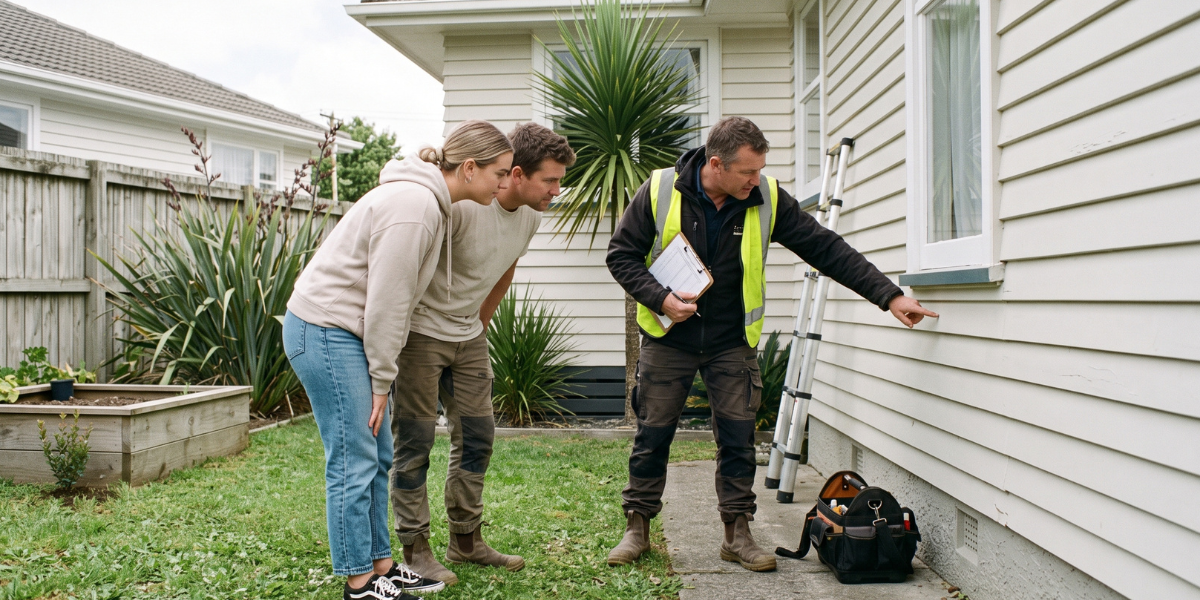
Here is one of the most effective things a buyer can do: ask to attend the last 30 minutes of the inspection.
Using the report to negotiate
A building report is not just a list of problems; if managed correctly alongside your solicitor and real estate agent, it is a highly effective negotiation tool.
If the report uncovers genuine issues, you generally have three options:
- Ask for a price reduction: If the report reveals the house requires $15,000 to upgrade the electrical wiring to current safety standards, your solicitor can request a reduction in the purchase price to compensate for those upcoming repair costs. Before you agree to this, make sure to let your adviser know as it does affect lending.
- Make the seller fix it: You can instruct your solicitor to request that the vendor repairs the specific defects (using certified tradespeople) prior to the final settlement date.
- Walk away: If the report reveals a catastrophic issue—like hidden weathertightness failure—and your contract includes a standard building report condition, your solicitor can use this to legally cancel the agreement, allowing you to walk away with your initial deposit intact.
At Home Loan Factory, we work alongside your solicitor to ensure your finance timeline aligns seamlessly with the protective conditions in your Sale and Purchase Agreement.
Getting ready to make an offer? Book a free mortgage strategy session with a Home Loan Factory adviser today.