
A quick heads-up: The information in this article is designed as a general educational guide only and does not constitute personalised financial, tax, or legal advice. Because everyone's situation is unique (and bank policies change frequently), we recommend speaking with a licensed Financial Adviser to see how this applies to your specific circumstances. For full transparency on our terms of service, how we are remunerated by lenders, and any specific situations where a fee may apply, please read How We Get Paid.
When you are hunting for an apartment, townhouse, or terraced home in New Zealand, you will almost inevitably encounter three words that make many first-home buyers pause: Body Corporate Levies.
It is completely understandable to see an annual fee of $4,000 or $5,000 attached to a listing and think, "Why would I pay that on top of my mortgage? That feels like throwing money away."
However, when you break down how a Body Corporate operates and where those levies are spent, you quickly realise you aren't throwing money into a black hole. In many cases, you are simply pre-paying the exact same insurance and maintenance costs you would have to pay if you owned a standalone suburban house.
Here is a straightforward guide to how a Body Corporate actually works, what those annual fees cover, and how to spot a well-run building.
What exactly is a Body Corporate?
When you buy a traditional standalone house, you own the building and the parcel of land it sits on.
When you buy an apartment or an attached townhouse, you are generally buying a Unit Title. This means you own the interior of your individual unit, but you share ownership of the common property with your neighbours—such as the roof, exterior cladding, entrance foyers, lifts, driveways, and landscaped grounds.
Because the building is shared, everyone needs to contribute to looking after it. Under the Unit Titles Act 2010, the moment you purchase a unit title property, you automatically become a member of the Body Corporate.
The Body Corporate is simply the collective group of all unit owners in the complex. Together, you are legally responsible for maintaining, insuring, and managing the shared assets. To fund this, the Body Corporate charges every owner an annual fee, known as a levy.
Not just high-rises: where you will find unit titles
Many buyers assume unit titles only apply to inner-city apartment towers. While almost all high-rise apartments are unit titles, the structure is widely used across New Zealand for all kinds of medium-density housing:
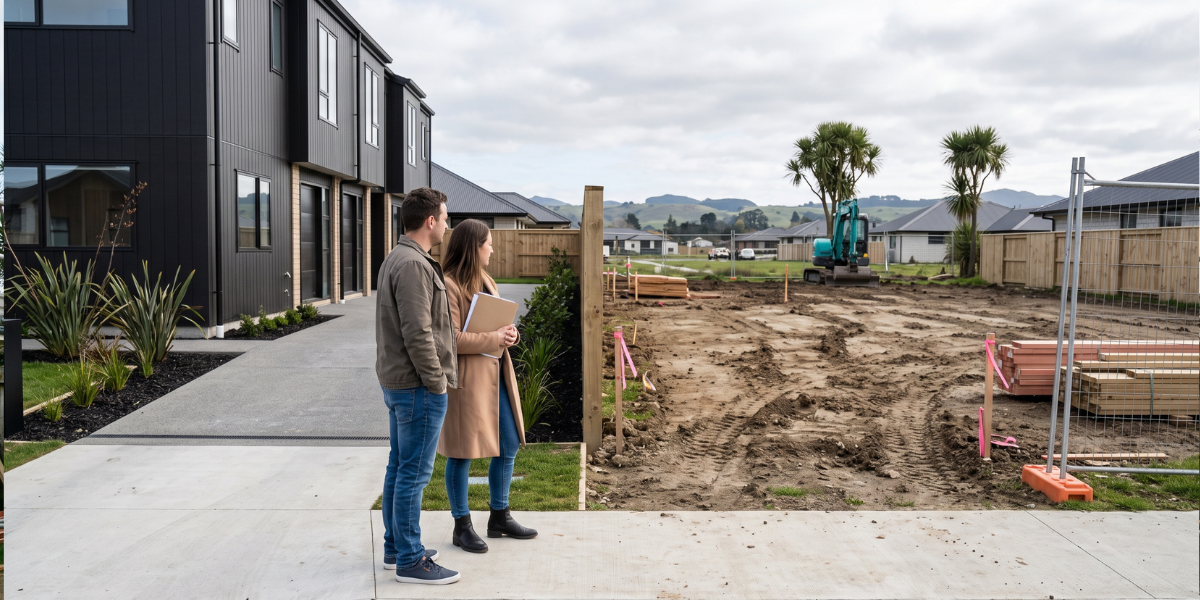
- Townhouses and terraced homes: Many modern, multi-level suburban townhouses operate under a unit title. You own your specific two-storey home and private courtyard, but share the main roofline, retaining walls, external cladding, and private access roads with your neighbours.
- Gated communities: Detached houses in private subdivisions are sometimes unit titles if residents share communal assets like private roads, entry gates, tennis courts, or a swimming pool.
- Mixed-use developments: A residential townhouse or apartment sitting above commercial shops or cafes will often share a single unit title framework.
Because you are buying into a shared structure, lenders evaluate the overall health of the complex alongside your personal finances.
Where your annual levy money actually goes
When you pay your annual Body Corporate levy, your funds are typically divided across four main areas to keep the building running smoothly:
1. Comprehensive building insurance
This is generally the largest portion of your annual levy. By law, the Body Corporate must insure the entire complex to its full replacement value.
2. Day-to-day maintenance and operational costs
This bucket covers regular operational running costs. It pays for lighting in common corridors, grounds maintenance, lawn mowing, rubbish collection, window washing, and the routine servicing of lifts and fire alarm systems.
3. Professional management fees
Most medium-to-large developments appoint a professional Body Corporate management firm to handle administration. This fee covers their work organising Annual General Meetings (AGMs), maintaining financial accounts, collecting levies, and ensuring the building complies with health and safety standards.
4. The Long-Term Maintenance Fund (LTMF)
This is arguably the most critical component. New Zealand law requires every Body Corporate to have a Long-Term Maintenance Plan looking ahead at least 10 to 30 years.
A portion of your annual levy goes directly into a dedicated savings reserve (the Long-Term Maintenance Fund). When the complex needs a major capital upgrade—like a roof replacement in 12 years or exterior repainting in seven years—the money has already been accumulated in the bank.
Why a suspiciously cheap levy can be a red flag
When reviewing listings, you want to see a Body Corporate that charges a realistic annual levy and maintains a healthy Long-Term Maintenance Fund.
If you come across a complex where the annual levy looks unusually low (say, $1,500 a year for an older building), approach with caution. A low fee often indicates that the owners have voted against funding their maintenance reserve to keep immediate costs down.
How Body Corporate fees compare to owning a standalone house
When you compare the total running costs of a unit title to a standalone freehold house, the numbers often balance out more closely than people expect.
If you buy a standalone house, there is no Body Corporate levy. However, you must pay your own annual house insurance policy, fund your own exterior repainting every decade, repair your own roof when it develops a leak, clear the gutters, and replace your own fencing.
With a unit title, those same maintenance and insurance costs are simply pooled across all owners and budgeted for in regular instalments. For busy professionals or anyone wanting a low-maintenance home, having shared upkeep managed centrally can be a practical, stress-free trade-off.
How lenders factor levies into your borrowing power
When you apply for a mortgage on a unit title, the bank will factor the annual Body Corporate levy directly into their affordability calculations as a fixed ongoing commitment.
For example, an annual levy of $4,800 is treated by the bank's calculator as an ongoing cost of $400 per month. Just like personal loan repayments or vehicle costs, that outgoing reduces your calculated spare cash, which can slightly trim your maximum borrowing capacity.
Checking your numbers on a unit title
If you have found a townhouse or apartment you like, looking at the Body Corporate levy is one of the very first steps we take.
At Home Loan Factory, we can plug the property's exact levies into our bank calculators before you make an offer. We will show you precisely how the fee affects your borrowing capacity, check how different lenders view that specific complex, and help you structure your application for a smooth approval.
Found a unit title property you love? Get in touch with the team at Home Loan Factory today for a clear, easygoing chat about how the numbers stack up.